
Invisible in Plain Sight: The Color Science Behind Meccha Chameleon
Meccha Chameleon looks like a party game for people who want to goof around painting themselves funny colors, but it plays like a close-reading test where the reward for attention is thirty seconds of being completely invisible to twenty-three other people.
| Genre | Multiplayer Hide-and-Seek / Party |
| Platform | PC (Steam) |
| Release | June 9, 2026 |
| Players | Up to 24 per match |
| Modes | Standard, Infection, Double, Reverse Chicken Race |
The Two Roles and Why Each Feels Completely Different
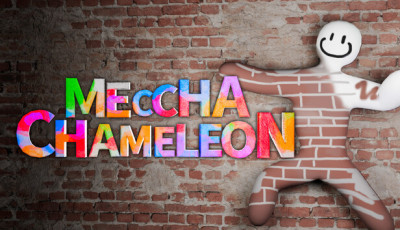
Every match in Meccha Chameleon divides players into Chameleons and Hunters. Chameleons are the Hiders — each one starts as a fully white humanoid figure standing in a colorful environment, with a short preparation window to paint themselves into invisibility before Hunters begin searching. Hunters move through the map trying to spot Chameleons before time runs out. The roles share the same map but play nothing alike, and which side you enjoy more tends to split the player base down the middle fairly cleanly.
Playing as a Chameleon is quiet, high-concentration work. You are managing three variables simultaneously: color matching the surface behind you, adjusting brightness and paint opacity so your skin reflects light the same way the background does, and positioning your body so your silhouette does not break the geometry of the scene. On the Osaka map, for example, a Chameleon who samples the correct red-orange from a lit lantern but fails to account for the shadow gradient below it will look perfectly fine from thirty meters away and completely wrong from five. Hunters who know the maps well walk toward anything that seems right but not perfectly right.
Playing as a Hunter feels like being an art critic with a time limit. The map is full of details, many of them visually similar, and you are trying to identify one specific kind of wrongness — a shape that does not belong, a color that is one step off, a shadow falling in the wrong direction. Players who describe themselves as visually observant, or who do illustration work and are trained to spot tonal inconsistencies, tend to perform extremely well as Hunters without needing much practice. That is not universal — some skilled Hunters say they perform by logic and pattern rather than pure visual sensitivity — but the game rewards close looking more than reflexes.
Painting Mechanics: What the Color Picker Actually Does
The 3D color picker is the central tool for Chameleons, and it is more nuanced than the tutorials suggest. Pointing it at any surface and sampling will give you the exact tone of that surface point — not an averaged tone, not a simplified approximation, but the literal color value at that pixel. This is significant because the same map has dozens of micro-surfaces that look identical from normal player distance but differ by several degrees of hue and brightness when sampled precisely.
What makes this matter is that Hunters learn over time to spot painted skin that is tonally correct in hue but wrong in brightness. A wall in direct light and a wall in shadow have the same base color but completely different luminosity values. Chameleons who sample from the lit portion of a surface and then stand in a shadowed corner of that same surface are not actually invisible — they just look slightly wrong in a way that experienced Hunters can identify within a few seconds. The advanced technique is to sample from a surface point that matches the ambient light at your exact position, which requires quickly reading how the map's lighting falls and choosing your sample point accordingly.
The paint brush itself received a resolution update after launch, which made fine detailing easier. Before the update, players complained that painting small body regions like fingers and face edges was imprecise enough to leave white gaps that Hunters could spot immediately. Post-patch, these gaps are noticeably rarer, and the community consensus shifted from "paint fast and hide before Hunters notice" toward "take the extra ten seconds to finish the edges."
Osaka: The Official Map That Defines the Game's Balance
The Osaka map is the most played and most discussed official stage in Meccha Chameleon. It is set in a dense Japanese street environment — shopfronts, lanterns, street-level clutter, overhead signage — and it rewards Chameleons who understand vertical positioning. The map has clear sight lines down its central lane, which means Chameleons who try to hide in the middle ground almost always get spotted during the Hunt phase. The genuine hiding space is in the cluttered side sections: the recessed shopfront alcoves, the stacked crates near the south end, and the three overhead positions accessible by jumping onto specific awnings.
Osaka received a significant rework after launch, with the stated goal of improving balance between Hunters and Chameleons. Before the rework, certain alcove positions allowed Chameleons to face directly away from any Hunter approach angle, which meant a well-painted Chameleon in those spots was functionally undetectable. Post-rework, those positions have adjusted geometry that exposes at least one angle to a Hunter sweep. Some veteran Chameleons have complained that this made their best spots obsolete; the counter-argument in community discussions is that those spots were not skill-based hiding but map exploitation, and that the rework made Osaka more interesting rather than less.
By the time you have played twenty or thirty rounds on Osaka, you develop a mental map of where the "wrong" Chameleons tend to be — the spots beginners return to because they got away with it once. Experienced Hunters check those spots first as a matter of habit, which has created an interesting secondary layer of strategy where Chameleons who know this pattern deliberately avoid beginner spots even when those spots would otherwise be strong choices.
Infection Mode and the Cascade Mechanic
In Infection mode, every Chameleon who is caught by a Hunter immediately switches to the Hunter team and begins searching for remaining Chameleons. This single rule change transforms the social dynamics of a match entirely. Early in a standard Infection round, the Hunter team is small and Chameleons feel relatively safe. Once the first few Chameleons are caught, the Hunter team grows rapidly and the remaining Chameleons — who may have been hiding comfortably — suddenly face four or five Hunters instead of two.
The strategic implication for Chameleons in Infection is that the first player caught is under the most pressure, because they immediately become a threat to everyone they were hiding near. Players who know each other from regular sessions develop informal agreements about staying spread out, specifically to avoid one converted Chameleon exposing a cluster of five people who all chose the same good hiding spot. In public lobbies this coordination does not exist, which makes Infection in public matches more chaotic and often more comedic than in private sessions.
Competitive-minded players tend to prefer standard rounds for their clean win conditions. Players who enjoy watching the game shift shape mid-match favor Infection. Both groups are right about what they want, and Meccha Chameleon is flexible enough to serve both without forcing either into an uncomfortable mode.
Double Mode: Everyone Hides, Then Everyone Hunts
Double is Meccha Chameleon's attempt to give every player both experiences in a single session without switching roles. In the first half of a Double round, all players are Chameleons — everyone hides at the same time. In the second half, all players become Hunters and try to find as many hidden Chameleons as possible. The player with the most finds at the end wins.
This creates a specific tactical tension that does not exist in other modes: you want to hide well enough to survive the Hunt phase, but you also need to be in a position from which you can quickly start searching when your role flips. Chameleons who hide in the deepest, most inaccessible corners of the map tend to survive the Hunt phase intact but then spend the first half of the Hunt phase just navigating back into the open, costing them valuable search time. The optimal Double positioning is a spot that is genuinely difficult to find but easy to exit quickly — and on most maps, those two criteria are in direct conflict.
What the Minecraft Workshop Map Changes About the Game
The Minecraft-themed community Workshop map is one of the most downloaded and most discussed custom stages in Meccha Chameleon's Workshop library. The blocky, right-angle geometry of the Minecraft aesthetic creates a fundamentally different hiding challenge: color matching becomes less important than silhouette matching. In organic environments like Osaka, a curved shoulder can disappear into a curved shopfront prop. In the Minecraft map, every surface is flat and perpendicular, and any curved part of your body outline that falls against a flat block surface is immediately legible as a human shape.
Chameleons on the Minecraft map need to prioritize poses that remove curved outlines. Lying completely flat against a floor surface — where your vertical profile is minimal — is more effective than crouching against a wall where your shoulder and head still create a recognizable shape. Players who come from strong Osaka performance sometimes struggle on this map specifically because the skills transfer differently than expected.
The Friendslop Debate and What It Means for Meccha Chameleon
The community label "friendslop" has followed Meccha Chameleon since the first week of release. In gaming discourse the term carries a specific meaning: a social game that relies on the chemistry between friends rather than depth of design, where the game itself is almost incidental to the fun. The debate around whether Meccha Chameleon fits this label is genuinely split. Players who argue it does point to how quickly a group of strangers in a public lobby can feel flat — the comedy of hide-and-seek in this format relies on knowing the person you are hunting, which makes the game's best moments inherently social rather than mechanical.
Players who push back on the friendslop label point to the genuine skill ceiling on both sides: a Chameleon who understands brightness sampling and pose optimization is measurably harder to find than one who does not, and a Hunter who grid-searches methodically finds more Chameleons per round than one who sweeps randomly. That measurable skill gap, they argue, puts Meccha Chameleon above the category. The honest answer is that both things are true: the game is funnier with friends and more skillful with experience, and those two qualities are not mutually exclusive.
Meccha Chameleon arrived at 15 million sales in roughly one month, and the number makes sense once you have played a round where a Hunter walks within arm's reach of a perfectly painted Chameleon and keeps moving. That moment — the Hunter passing, the Chameleon holding perfectly still against the Osaka lantern glow — is the game in microcosm: tense, funny, and entirely dependent on whether your brightness sampling was one degree off.